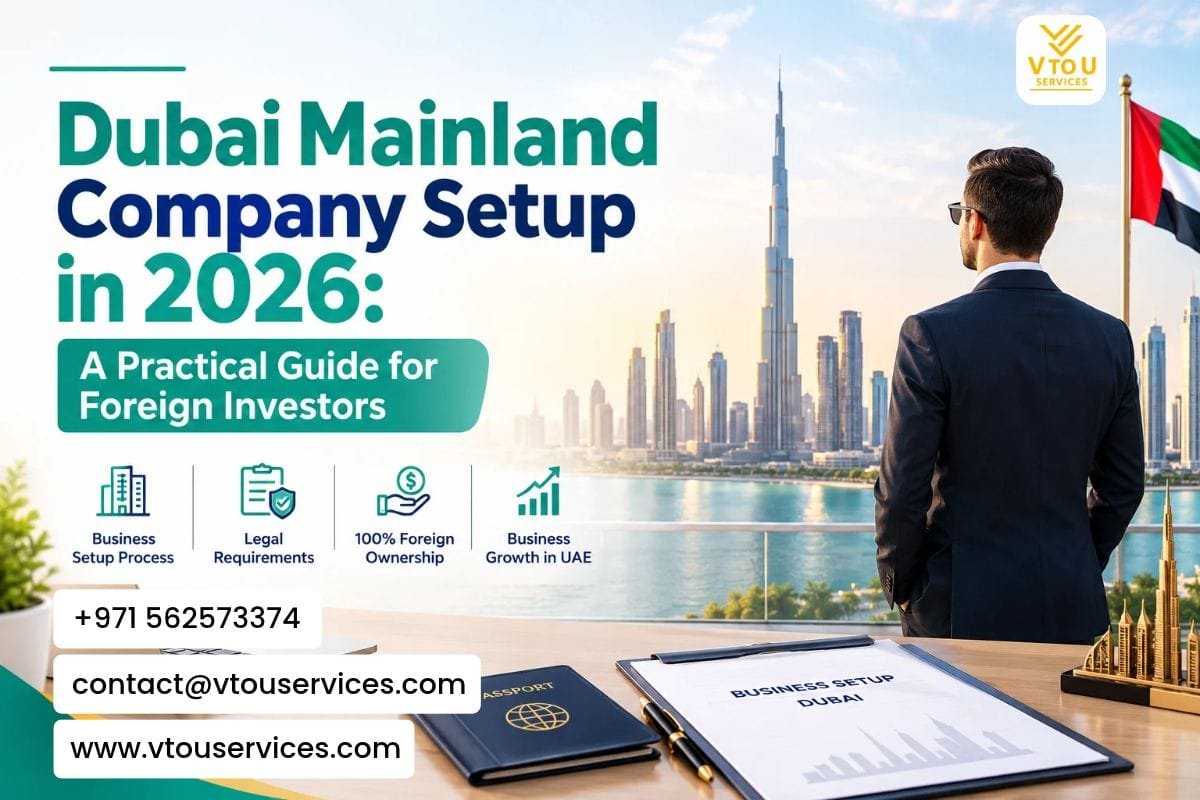
Dubai mainland company setup lets you license a business directly with the Department of Economy and Tourism (DET), the authority formerly known as the DED. Since the reforms that took effect in 2021, most mainland businesses can be 100% foreign-owned, which has made mainland a serious option for founders who once needed a local partner.
This guide explains how mainland setup works, what has changed, what it costs, how corporate tax applies, and how to decide whether mainland suits your business.
Key takeaways• Ownership: most commercial, industrial and service activities allow 100% foreign ownership. • Market access: a mainland licence lets you sell directly across Dubai and the wider UAE. • Timeline: a straightforward commercial setup can often be completed in a few weeks; regulated activities take longer. • Tax: 9% corporate tax on taxable profit above AED 375,000 (0% on the first AED 375,000). • Biggest risk: choosing the wrong activity code or an incomplete quote. |
What Is a Dubai Mainland Company?
A mainland company is licensed by DET to operate in Dubai’s mainland areas, outside free zone boundaries. Most mainland companies are structured as a limited liability company (LLC), and the licence sets out the activities you are allowed to carry out.
The biggest advantage is market access. A mainland licence lets you sell directly to customers across Dubai and the wider UAE and bid on many local contracts, including some government work where licensing rules apply. A free zone company is generally restricted from doing direct business with the local market unless it works through a distributor or opens a mainland branch.
Read more: Company Registration in Dubai, UAE
100% Foreign Ownership: What Has Changed
Before the recent reforms, foreign investors typically had to give a UAE national partner a majority stake. Since 2021, most commercial, industrial and service activities allow full foreign ownership with no local sponsor. That covers trading, consultancy, technology, marketing, logistics and many other sectors.
There are two caveats to keep in mind:
- Not every activity qualifies. Some strategic or regulated sectors still require a UAE national partner, a service agent or specific approvals.
- Some professional licences need a Local Service Agent even when ownership is fully foreign.
Confirm the exact activity code before you commit, because the activity on your licence determines what you can legally do.
Why Founders Choose Mainland
Mainland is a strong fit if you:
- Need to sell directly to Dubai and UAE customers
- Want to bid on government or semi-government work
- Plan to operate a shop, restaurant, clinic or other service location
- Expect to grow your team, since visa quotas are linked to the size of the office you lease rather than being fixed by a package
Dubai Mainland vs Free Zone
A free zone can suit businesses focused on international trade, holding structures or activities with no local sales. A mainland company suits businesses that depend on the local market. Many companies use both: a free zone entity for international trade and a mainland company or branch for sales in Dubai and the UAE.
| Mainland | Free zone | |
| Selling in the UAE market | Direct, across Dubai and the UAE | Generally, through a distributor or a mainland branch |
| Government contracts | Eligible for many, where licensing rules apply | Generally restricted |
| Office | Often required, backed by Ejari (depends on activity) | Provided by the free zone authority |
| Visa quota | Linked to the size of your leased office | Typically set by the package |
| Best for | Local sales, shops, clinics, services, tenders | International trade, holding structures |
How to Set Up a Dubai Mainland Company: Step by Step
- Choose your activity codes. Your licence only covers the activities listed on it.
- Reserve a trade name. The name must follow DET naming rules.
- Prepare your documents. Usually passport copies, the memorandum of association, and details of shareholders and managers.
- Arrange your office. A physical office is often required, usually backed by a registered tenancy contract (Ejari), though requirements depend on the activity.
- Obtain external approvals if needed. Regulated businesses such as food, health or education need approvals from the relevant authority before or alongside the licence.
- Pay fees and receive your licence.
- Open a corporate bank account and arrange visas. Once the licence is issued, you can open your bank account and apply for residence visas.
A straightforward commercial setup can often be completed in a few weeks, while regulated activities take longer.
Dubai Mainland Company Setup Cost
Costs depend on the activity, the licence type, the office, the number of visas and any approvals you need. Ask any provider for an itemised quote that covers:
| Cost item | What to check |
| Trade name | Reservation and registration fees |
| Licence fee | Depends on activity and licence type |
| Chamber membership | Whether it is included or charged separately |
| Office and Ejari | Office type, size and annual rent |
| Visa and medical costs | Per visa, including medical and Emirates ID |
| Approvals | Any external authority approvals for regulated activities |
| Bank account charges | Opening and ongoing fees |
Watch out: a low headline price that leaves out these items is a common reason budgets go wrong. Always ask for the full, itemised figure before you pay anything.
Corporate Tax and VAT for Mainland Companies
UAE corporate tax applies to mainland companies at 9% on taxable profit above AED 375,000, with 0% on the first AED 375,000. Qualifying free zone income is treated differently, but mainland profits generally fall under the standard rate.
You should also check VAT registration, which is mandatory once taxable turnover passes AED 375,000. Keep accurate books from day one, because tax registration and filing deadlines are firm.
Common Mistakes to Avoid
- Choosing the wrong activity code, which can limit what you are legally allowed to sell.
- Underestimating office and Ejari requirements.
- Assuming one licence covers every activity, you want to offer.
- Missing tax registration deadlines.
- Working with an agent who won’t itemise fees, which is a warning sign.
How VTOU Services Can Help
Every business is different, and the right activity code, office and visa plan depend on your model. With us you get:
- A review of your business activity and the correct licence activity codes
- A clear, itemised quote with no hidden items
- A realistic timeline and budget before you commit
- Support through licensing, office and Ejari, visas and banking
Ready to set up your Dubai mainland company?Book a free mainland setup consultation and we’ll map your activity, timeline and budget before you commit. Book Your Free Consultation → vtouservices.com |
Frequently Asked Questions
Can a foreigner own 100% of a Dubai mainland company?
Yes, for most commercial, industrial and service activities. Some strategic or regulated activities still require a UAE national partner or service agent.
Is a Dubai mainland company subject to corporate tax?
Yes. Taxable profit above AED 375,000 is taxed at 9%, and the first AED 375,000 is taxed at 0%.
Can a Dubai mainland company trade across the UAE?
Generally yes, subject to the activities on your licence and any rules specific to each emirate.
How long does a Dubai mainland company setup take?
A straightforward commercial setup can often be completed in a few weeks. Regulated activities such as food, health or education take longer because they need external approvals.
Do I need an office for a mainland company in Dubai?
A physical office is often required, usually backed by a registered tenancy contract (Ejari), though requirements depend on the activity.
How much does a Dubai mainland company setup cost?
It depends on your activity, licence type, office, number of visas and approvals. Ask for an itemised quote covering the trade name, licence, chamber membership, office and Ejari, visas, medicals and bank charges.
Should I choose mainland or free zone?
Choose mainland if your business depends on local sales, government work or a physical location. Choose a free zone if you focus on international trade or holding structures. Many companies use both.